There are these types of mosquito killer racket are easily available in market at some 150 rupees.
This consist an electric fence in the bat portion which has 5000-10,000 volts passing through them. This is not only mosquito repellent, it’s insect zapper. When a mosquito gets in contact the high voltage burns it. The inner circuit consists of battery, a charging unit, and a HV inverter circuit, which I’m going to describe here.
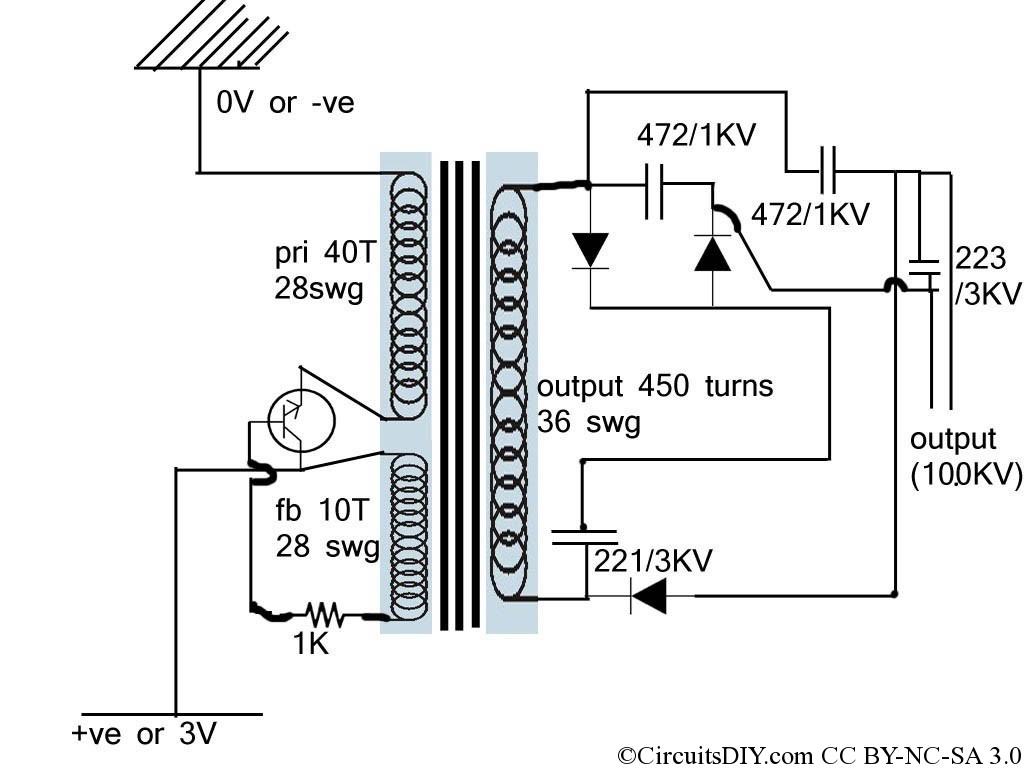
Coil turns will be as described in text and not the one indicated in this tmage.
The circuit consists of a flyback topology transformer driven by a general NPN transistor 2SD965. The feedback coil of transformer is of 10 turns, the primary is of 40 turns and the output or secondary coil is of 450 turns. When this circuit is run by 3Volts, the transformer generates about 2000-4000 volts at zero load, and the output is then coupled 3 times by using 3 IN4007 diodes and suitable capacitors, thus reaching our need of 5000-10,000 volts.
Note: All diodes used in circuit are IN4007 diode, The transistor is 2SD965, and can’t be replaced by BC548, The transformer should be ferrite core.
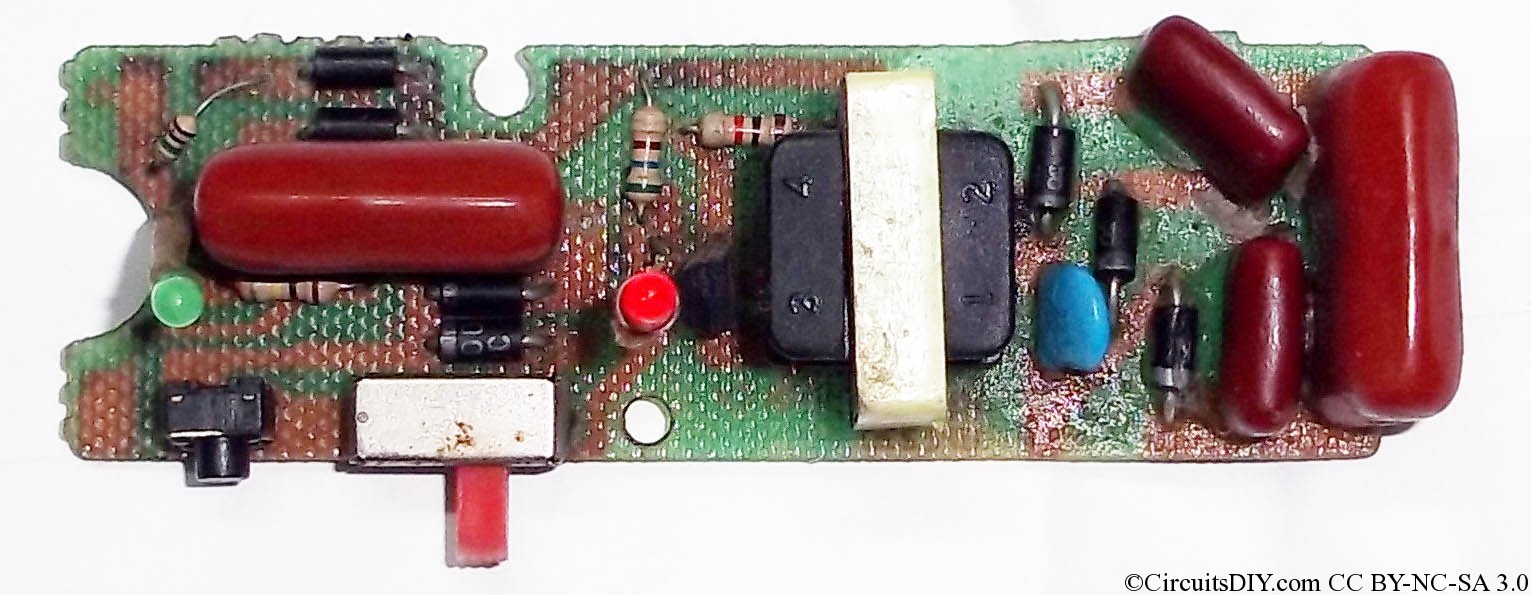
Below an actual circuit board found in mosquito zapper rackets.
sir i want to make this project as size of bed what will be the changes in the circuit can you please reply mi sir.its urgent
Pls can you send me the comprehensive circuit diagram of the mosquito fence.
Fantastic posting. I had been verifying continuously this particular blog page and I'm inspired! Handy data precisely the ultimate portion 🙂 I personally retain similarly info a lot. I was in search of this particular particular facts for the number of years. Appreciate it and good luck.
Hi Arup,
How to calculate the transformer winding for secondary and primary turns and how to choose the swg size?
Regards
Rajkumar.M
Hi Arup,
How we will calculate the turns ratio for primary and secondary and feedback transformer and swg thickness of the copper wire?
Regards
Rajkumar.M
Sir,
If i put 240v ac to the fence,what happen.will it work.and kill the mosquito.
sir,
can i charge 6v 4.5ah battery using this circuit
Needs fence for rat control. Can i get the ready made ckt... Regards
Arup was fried to death while modifying his mosquito bat!
Though the output voltage is thousands of volts so why the current is safe for humans
your circuit seems incomplete with 4 diodes and 3 resistors are missing upon comparing above pcb and circuit diagram
4 diode and 3 resistor "Its an another circuit which is used for convert the input power 230v into 3-6v DC by 4 diode rectifier bride circuit and 3 resistor reduce the voltage which is used for charge the 3 volt battery, and given circuit diagram is repellent ckt diagram.
how is the high voltage racket work without kiling its user
Hi Arup. i want to talk to u over the phone. so please send me ur phone no to my mail id. nithil.cl87@gmil.com. i have an idea. but dono how to start it so need help of urs.
pls send me one by one part of circuit devicess
uhh hello can are ya saying here that battery need 6 volt to charge that battery?
it3 v right can u pls tell in how many hour i can charge that bttery if make a diff charger with 6 v to charge that battery ?
pls ty
email push.pk.a7@gmail.com
or u can reply here i will wait your reply
thank you
The battery in mosquito bats is a small 4 V, lead-acid. Generally you need to charge them for 3 to 4 hours at 200 mA current.